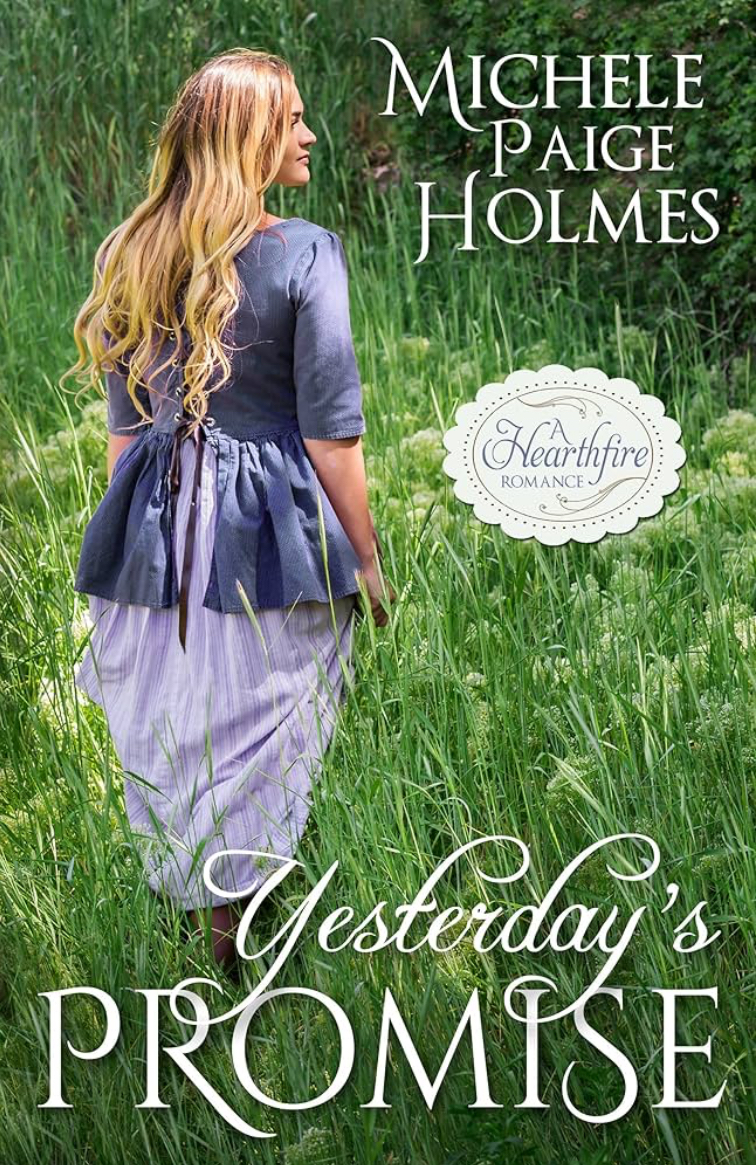
Yesterday’s Promise
Prologue
The Scottish Highlands, September 1746
Collin
“Is this the lad?” A wizened man seated at the head of the long table squinted, bunching the skin surrounding his eyes into folds. His coarse, grey beard dragged across his knees as he pushed back his chair and angled toward me.
I suppressed a shudder. Liam Campbell looked older than the stone walls of his keep, but he appeared every bit as fierce as rumored. The infamous scar he’d earned during the early days of the Watch crisscrossed his left cheekbone and traveled up to where his eyebrow should have been. His jaw set in what appeared to be either anger or hatred— likely both— and I wondered uneasily whether he’d taken me of his own accord or if he acted under the direction of the English.
Either way, this couldn’t be good. And either way— I’d meet my fate head on as Da met his.
I straightened as best I could, which wasn’t much, held on either side as I was and with my hands still bound behind me.
“He must be the MacDonald rabble,” one of the men restraining me said. “Watched him spend the better part of yesterday digging Ian MacDonald’s grave.”
My chest burned at the mention of my father. The crude hole I’d dug for him hardly qualified as a grave. I glared at the old laird, my own hatred surfacing. When it came to the dead, Scotsmen usually had some sense of respect. But not Campbells, as far back as any history I’d ever heard. Probably the only reason they’d allowed me to care for Da at all was weariness from their own journey.
But I’d scarce placed his body and added a few handfuls of dirt when they’d come at me from behind. I’d not even been given a chance to find a suitable stone for a marker. And now my father lay cold and stiff, his body unmarked and unprotected on one of the Highlands’ endless moors.
“Release him,” Laird Campbell ordered. I stumbled forward with sudden freedom, only just catching myself from falling. Beside me the men laughed, and the jeers and titters of others echoed throughout the vast hall.
I looked up to see intent grey eyes studying me closely. Laird Campbell was not amused.
“Untie him and get him some food.”
A woman hovering near his chair hurried away as I felt a dirk slash through the rough rope binding my hands. Just the mention of food was enough for the hollow ache in my gut to flare to life, reminding me that I’d not eaten in three days.
Since Da and I had shared the mush he made from the stolen barley. I pushed the thought from my mind and set about rubbing my wrists, attempting to restore circulation.
Laird Campbell turned his attention to the clansmen who’d brought me in. “The lad’s fair starved. Instead of watching him labor you ought to have helped, then given him some bread.” His voice was sharp with reprimand. “It’s a miracle he hasn’t followed his father to the grave yet.”
Yet? Because you plan to see to it personally? Did he want me fit enough to endure whatever torture he had in mind, or did he want me alive to hand over to the English, who were well known for their own cruelty and punishments? I wasn’t sure what he thought either option would accomplish. At this date there was nothing left to tell, no secrets the English had not uncovered. Bonnie Prince Charlie had safely fled Scotland, leaving his loyal supporters behind to suffer the consequences of his failed bid for England’s throne. I met Laird Campbell’s steady gaze and kept my focus there, though I heard the uneasy shuffle of his men.
The one on my right spoke up. “We passed half a dozen English patrols on the way. Could have turned him over to any one of them and received a nice purse.”
“It is well you did not.” Laird Campbell’s ominous tone sent a shiver up my spine.
The man on my other side cleared his throat. “You didna’ say—”
“Must I say everything? Some things ought to be obvious!” The laird’s words reverberated off the walls. He grabbed a staff leaning against the table and slammed it onto the stone floor. “You were to bring me Ian McDonald’s son, alive and well.” He pushed a tankard down the table toward me. “Drink.”
Wariness that this was some sort of trick was no match for my overwhelming thirst. I stepped forward, took up the cup and gulped down its contents— lukewarm water.
“Fetch him another,” the laird ordered, and the cup was whisked from my hand by a second woman lingering nearby. “How long since you’ve last eaten?” the laird asked me.
“Three days.” It hurt to answer. The half cup of water hadn’t been nearly enough to soothe my parched throat.
“Three days.” The laird pointed the staff at the men on either side of me. “That is when each of you shall eat again. While you are awaiting your next meal, you’ll have ample time to think on following orders. Take them below.”
I didn’t turn to watch the proceedings behind me but registered that they occurred without protest or fight. Liam Campbell was both respected and obeyed, it seemed. I kept my eyes on him, appraising, wondering if he was still as tough as the wounds he’d earned, or if age had made him vulnerable. I could only think that if his wrath kindled at so little a grievance from his own people, things did not bode well for me, a MacDonald and therefore an ancient enemy. But the tone the laird used next was different from the one directed at his men.
“What’s your name, son?”
My eyes snapped to his as Da’s bullet-riddled body sprang to mind. I stepped closer. “Collin MacDonald— Laird MacDonald now, since you’ve murdered my father.” I spat and watched with satisfaction as my saliva hit near its mark and slid down the laird’s cheek.
A collective gasp echoed around the room. I jerked backward as my arms were seized again.
He shook his head, and his men fell back. “So we ended up with Collin, did we?” His gaze was upon me once more. “You should be grateful. Your brother mayn’t fare so well. And I shouldn’t be certain of your status as laird just yet— second born, as you are.”
“Ian’s dead.” I thought of my twin brother as I had seen him last, a fortnight ago, his body still and twisted at the bottom of a ravine near Munro lands.
“Is he, now?” Laird Campbell said slowly, and in such a manner as to make me question what I’d thought to be true. Da said to leave him, that there was naught to be done. I pictured my father’s grief-stricken face as he’d scrambled back up the hill. The watch had been just behind us, and we’d barely made our escape that night— the only time I’d ever heard my father cry.
“All is not always as it seems,” Laird Campbell said, bringing me back to the present. What was he talking about? Did he have Ian here, too? I glanced around, half-expecting to see him brought in wearing chains, or to see a man with an axe approaching, or to feel a pistol held to my head. But Laird Campbell had made no move to wipe his face, and appeared, if anything, less hostile than when I’d been brought before him. If his aim was to make me uneasy, it was working.
He drummed his bony fingers on the table as he stared at me. “Bravery— an admirable quality.” He nodded slowly. “But pride is foolishness.” He shook his head. “The downfall of many great men, many a MacDonald.”
He lifted a rag from the table and held it out to me. “I’ve no desire to start off on the wrong foot. I’ll take your apology and my face cleaned, or you’ll be taking a trip outside with my men for a thrashing.”
Because he was too old to do it himself? My hands clenched into fists at my sides. Da barely in his grave, and the man responsible for his death expected an apology? Next he’d be wanting my fealty. I lifted my chin and met his gaze steadfast. “Whatever purpose you’ve brought me here for, you cannot succeed. You’ll not have me. Do what you’d like to my body, but you’ll not have an apology or anything else.”
A wicked smile curved the old laird’s lips. “Did I want a body to do something with, it would not be yours, lad.”
The hall erupted in laughter. I felt my face burning scarlet but told myself not to mind. What was humiliation compared to what I’d been through these past months? I’d survived the English dogs this long. I wasn’t about to let one of my countrymen— traitor though he was— take any satisfaction from me.
Pursing my lips, I steeled myself against what was to come. How bad can it be? It wasn’t as if I’d never been beaten before. Da had taken a switch to my backside more than a time or two. I’d just pretend it was him. I’ll take it for you, Da.
“Stubbornness,” Laird Campbell said. “Another questionable trait. Though I suppose I should expect no less from a MacDonald.”
I fought the urge to spit on him again. “The MacDonalds are strong, too. We’re the oldest, most powerful clan in the Highlands.”
“Once, long ago,” Laird Campbell said. “But now…” His voice trailed off, almost as if he didn’t wish to recount the obvious.
For our loyalty to the prince, we had been nearly annihilated. Laird Campbell’s gaze seemed to soften. His mouth turned down, and his eyes drooped as if sorrowful. For a fleeting second I wondered whether he regretted the punishment he’d handed down or if he was mulling over the current, sad state of the Highland clans and Scotland in general. Either way, he’d no one to blame but himself. Had his clan sided with the Jacobites we might have had success instead of slaughter.
Another minute passed, and I sensed he was still waiting for me, giving me one more chance. I would not take it. I’d not grovel at the feet of my enemy. Not yet, anyway. Unease that had nothing to do with hunger stirred my innards. In the past year I’d seen men brought low under torture. I’d never experienced that suffering myself, but I’d seen pain reduce grown men to bairns. I wanted to believe more of myself than that. But at fourteen, I’d not yet been tried.
At last Laird Campbell nodded to his guards, and I almost felt relief when they took my arms and made to take me from the room. It was always better to get a punishment over with. Sometimes the dread was half the agony. Though, noting the strength of the two men who held me, I somehow doubted that would be the case.
“Wait!” A shrill, yet tiny voice halted our procession. I glanced over my shoulder as a lass, little more than a bairn herself, appeared behind the laird’s chair. She reached up onto the table and grabbed the cloth Laird Campbell had held out to me just moments before. “Don’t hurt him.” She spoke as if she was used to ordering others about. “I’ll clean Grandfather’s face.” She looked directly at me. “You’ll only have to say you are sorry.” She turned to Liam Campbell and, standing on tiptoes, reached to wipe his cheek.
He bent closer, allowing her better access, and a broad smile— genuine, this time— formed on his mouth, transforming the fierceness into a face nearly bearable. “That was very kind of you, Katie lass.” He picked her up and settled her on his lap. They both turned to look at me. “Well,” Laird Campbell asked. “You aren’t going to let my granddaughter’s generosity go to waste, are you?”
A sharp look at his men, and they released me, one of them muttering beneath his breath as he did.
“I—” I wasn’t sure what to say. I faced Laird Campbell and the girl. I’d not expected to have a waif of a child— and a lass at that— come to my rescue. It was humiliating, and any form of apology still went against grain. “I cannot apologize to the man who killed my father.”
“I didn’t fire those muskets, lad.”
“You might as well have,” I said. “You turned him in. You handed him over when you knew they’d kill him.”
“I did only what your father asked of me.”
“Liar!” I burst out. “That isn’t true.”
“It is.” Laird Campbell’s voice sounded heavy— tired. But also truthful, and as his arms wrapped protectively around the child in his lap, he didn’t look like a man capable of such brutal treachery.
Don’t be fooled. I reminded myself that his gruesome scar told another story— one of his early betrayal, an encounter with Grahams before they, and the other clans, realized that the Campbells were working for the English and had formed the black watch.
A nice way of phrasing the word spies, Da had said. A justification for using brutality against the other clans and in return receiving favors from the English.
“My father wouldn’t ask for his own death. He wasn’t a coward.” I thought of the cave and the supplies we’d been gathering there. We would have made it a few more months, at least. And while a life in hiding wasn’t the one Da was used to leading, I felt sure he hadn’t been ready to give up. He’d still had some fight left in him.
“No man as brave as your father chooses to die— without a reason,” Laird Campbell said. “But sometimes we wish those we love to live more than we care about our own lives— or deaths. Your father chose to turn himself in so you might live. He came to me and asked me to betray him, so you’d be given into my care, and so you’d be spared the fate of nearly every other MacDonald male.”
“That’s not true.” My breath left me as if I’d just been punched. I suddenly wished I was outside feeling the sting of a lash against my back instead. That was pain I could live with. The thought that Da might have faced a firing squad in order to save me was not. The Campbell laird had to be wrong.
He’s lying. “I wasn’t in any danger. I’m only fourteen. The English were only interested in the men— in those who fought.”
“You don’t look fourteen, lad.” Laird Campbell’s gaze strayed to my feet— large by any standard— then traveled up my lean body to the top of my head, nearly equal in height with most of the men in the room. “Your father sensed you were in danger, and he was right. As son of a laird, your name was listed on that execution order, alongside his.”
No, I wanted to cry out. It wasn’t true. It couldn’t be. I wasn’t in any danger so long as Da and I were together. And we were good at evading the English soldiers and watch alike. My father knew the hills and crags of the Highlands as well as anyone. We could have lasted a long time. He could have still been alive.
“MacDonalds were there to welcome the prince when he arrived, and MacDonalds smuggled him away at the last,” Laird Campbell continued, as if he thought I didn’t believe his claim about the price on my head.
“I know what we did.” I’d been there for most of it.
“Well, the English do not take it lightly, son.”
I bristled again at the use of the endearment. I couldn’t figure Liam Campbell out, or what he wanted from me. Not for the first time in the past two days I wished I’d disobeyed my father. If I hadn’t listened, if I’d come out of those bushes with him… I squeezed my eyes shut tight, closing out the light of the room and the strangers surrounding me. But all the darkness brought was the image of Da being led away and the echoes of shots.
“Aren’t you going to say you’re sorry?”
I opened my eyes to find the wee lass staring up at me.
“It isn’t nice to spit on people,” she said matter-of-factly. “Even when you’re sad or angry— or frightened— you should still be nice.”
My ire rose further at her reprimand, and I placed my fists on the table, leaned forward, and glared at her. “What does a little bit like you know about sorrow?”
Laird Campbell’s expression changed swiftly, to a twisted mass of scar tissue, even uglier and more frightening than the face that had first greeted me.
I’ve gone too far.
“She knows plenty,” he said, his voice deceptively quiet. “Her mother lies in that casket behind me.” He turned toward the dais at the back of the hall. I followed his gaze and glimpsed the long, wood box laid out across the trestle table. Flowers adorned the top of the casket, and candles burned nearby, on either end of the table.
It was a shock to see it there, to realize I’d not noticed before. With some consternation I realized I’d not taken stock of my surroundings. A quick glimpse around the room revealed no additional caskets, and my eyes returned to the lone box on the table. It was laid out with such respect— on the table they eat at, no less— that I felt neither remorse for my earlier words nor sympathy for the laird or his granddaughter.
At least her mother will have a decent burial. I hadn’t even a blanket to lay Father in and had lowered him into the ground with nothing covering him but his own, filthy, blood-smattered clothing.
I glanced from the casket to the child and saw that her impertinent look had dissolved into one of uncertainty and fear. With a tremulous sigh, she turned from me, burying her face in her grandfather’s shoulder.
At least she still has someone. I further justified my unkindness. But the thought didn’t carry the bitterness of my previous ones. I hadn’t the strength to hate the child. I didn’t want to hate her— or, at the moment, even Laird Campbell with the compassionate look he bestowed upon the lass and then me.
He is my enemy. I tried to rouse the anger I’d felt just moments before, but somehow the girl’s reaction had taken it from me. It wasn’t right that she had lost her mother. It wasn’t right that my parents were both dead and that what few clansmen I had left were strewn about, hiding and starving on their own land.
“How long?” I asked, looking past Laird Campbell toward the casket. “When did she—”
“Three days ago,” Laird Campbell said. “She was my only child. I would have gladly given my life for hers, so you see—” He paused, shifting his granddaughter’s weight before meeting my eyes again. “So you see how I could not deny your father’s request. When he asked me to see that you lived, that you were safe, I had to agree.”
I read the truth in Laird Campbell’s eyes even as my own smarted. I looked down at the weathered wood of the table and wished, more than anything, that I didn’t know the truth, and that I wasn’t beholden to this man for my life. That Da had not given his for mine. But there was no changing that now.
I swallowed the painful lump that had formed in the back of my throat and blinked rapidly to keep foolish tears at bay as I uttered the belated apology. “I’m sorry.”
Chapter 1
Alverton, England -June 1761
Katie
“Katherine Christina Mercer, come down here this minute—”
“—and help,” I finished in a nasally tone matching Mother’s when upset. I made no
move to answer her summons that sounded as if it were intended for a nine-year-old instead of a
mature, independent young lady of nineteen. Independent and artistic. I could not afford to be interrupted. Leaning back on my stool, I clamped the end of a well-chewed paintbrush between my teeth as I studied the canvas before
me. I squinted then sighed in frustration as I took in what I’d hoped was— but obviously was
not— a completed work. For while the scene appeared finished, something about it was not quite
as it should have been. And Lady Gotties, to whom I hoped to sell the painting, would surely notice as well.
“Christina!”
“Bother,” I muttered, more concerned with what ailed the painting than what troubled my mother.
I held one hand up, spreading my index finger and thumb wide, in an attempt at crude
measurement. Moving my hand in front of the canvas, I checked the distance between sky and
mountain, trees and meadow. The scale is good. That’s not it. Pensively I stared harder.
“Do not make me come up there.” Mother’s voice carried up the stairs again.
Little worry of that. I dismissed the threat as idle. Mother had never once been up to my
attic before. It seemed highly unlikely that she’d start tonight. I glanced out the window. It was
almost night. The time for finishing this painting— for finding and fixing what was wrong—
grew short. But when I looked back to the canvas my error seemed blatant. The hue of the sky was
wrong. No little mistake. And I’d so wanted to finish this piece tonight.
Perhaps, in better light… As a last hope, I stood and dragged the easel toward the
solitary window— definitely not the best source of light or the best view for capturing the
majesty of the sky on a summer day. I’d relocated up here out of desperation. Anything out in the
yard or in the house below that was at all movable had already been taken. Thus far I’d
managed to preserve my easel and supplies as well as everything dear to me by stashing my
belongings up here. That Mother knew of this and had not put a stop to it was likely because she
saw no value in the canvas and paints. Or anything else I own.
That was true enough, at least. Aside from being two seasons old,
or one of my few plain mourning frocks, the gowns I had left were mostly in a sorry state of disrepair. The silks that had once comprised much of our wardrobe were not designed with work
in mind. But I had done little else the past year. And with no other clothing to wear whilst doing
that work, the gowns had quickly become worn. Not to mention, too short. I uncrossed my exposed ankles and knew I’d have to let a hem out and find some trim to add to a gown tonight if I planned to visit Lady Gotties tomorrow. But there would be no point in visiting Lady Gotties if I did not have this painting
completed.
Pulling the brush from my mouth, I continued to study the landscape critically. The sky is
too light— too vast and blue. The sky in Alverton hadn’t looked that way for a long time.
Perhaps it never had. It was most often grey, and on particularly pleasant days— rare ones—
appeared more of a purple hue. The painting would have to be fixed.
Glancing out the window again, at the waning light, I wondered if I had enough time to
mix paints and rework the sky before the sun set completely. There wasn’t a lantern left to spare
for me to bring one up here, and even had there been, it would only have created more shadows
to contend with. I need to be out in the yard again. Brisk footsteps sounded on the stairs, jarring me from my contemplations. Mother? I jumped up to pull the latch on the heavy trap door, and not a second too soon, as her
grey-brown head appeared in the opening. Stepping back, I allowed her to enter the sloped room.
Once inside, she looked around the narrow space, crammed with canvases, jars of paints, stacks
of books, and the large trunk full of my clothing.
“You’ve made quite the nest up here, I see,” she said.
“It’s nothing anyone would have wanted,” I said defensively. “And it’s not hurting
anyone.”
“No one, except you.” Ducking her head she crossed the room on squeaky floorboards to
sit on the edge of the trunk. “Christina, you cannot hole up in here forever.”
“I know.” I looked across the room at the easel longingly. Outside the sun had nearly set.
“I’m almost out of canvas, and three of my colors have run dry. But I have a plan,” I added
hastily. “During her last visit Emma’s Grandmother, Lady Gotties, expressed interest in my
work. She’s coming again this weekend, and I intend to present her with a painting she might
wish to purchase.”
“You are not going to be here at the week’s end,” Mother said.
“What?” I searched Mother’s face, dread in my heart. I had known it might come to this,
had known that it would come to this eventually— that we would all be forced to go live with
some estranged aunt or other obscure relative kind enough to take us in. But not so soon. Father had barely been gone six months.
“The last of the furniture was taken today,” Mother said. “Our beds are reduced to
blankets on the floor for the night, and we’ll be taking our supper at the work table in the
kitchen. I sold the last of the livestock too.”
I nodded, not caring a fig about the furniture or the cow that had gone. My horse had
been sold three months ago, and I’d just as soon sleep on a pile of blankets on the floor as in the
four poster bed that used to be mine.
“Where will we go?” I asked. “How soon will the new tenants be here?” Will I be allowed to bring my paintings? Will there be time to visit Father’s grave again? Selfish thoughts, to be sure, when I should have been in the rooms below today, helping Mother. But it was difficult to feel selfish when I thought of Annabelle, one year younger than I, touring Europe on her wedding trip right now. She’d done nothing to help Mother settle the estate after Father’s
death, and had instead created a flurry of work for all of us, as we readied her trousseau and all
else for her wedding, just a few weeks previous.
“Will we be staying with Anna?” I asked. Staying with my sister wouldn’t be so bad. She
had married well and her new husband owned a vast countryside estate as well as a townhouse in
London.
“You will not be staying with Anna,” Mother said. “It wouldn’t be good for you— seeing
your sister happily married like that. It’s high time you thought of yourself, of your own
marriage.”
I bit back a harsh laugh. “No one will have me. My prospects were not promising before,
and now— without any sort of dowry and with father’s reputation— they are nothing.”
Which was all well enough for me. What did I want with a husband and babies when I could devote my
life to art? Once, in those years before our circumstances had changed, like any other young lady, I
had dreamed of balls and parties, of beautiful gowns and dashing suitors. But Father’s fall from
grace with the English government had changed all of that and at the worst possible time— just
before my London season was to have begun.
“I am sorry you did not get a season,” Mother said.
“It’s all right.” I crossed the room toward her.
Truly I didn’t mind anymore and hadn’t
quite soon after it had happened. Thinking back on that spring now, I realized that my quick
recovery illustrated how very little the whole affair had meant to me to begin with.
Instead of enjoying my seventeenth summer in town, spending a fortune on a new
wardrobe and attending balls and other prestigious social functions, I’d spent that summer
consoling my father, telling him he’d done the right thing in standing up to his superiors when he
believed they were wrong. I hadn’t understood, exactly, why Father was so strongly against the
Act of Proscription against the Scots, but speaking his mind about it had cost him his long-
standing post in the military. Where I had at least been sympathetic to his cause, Mother had been furious. I’d hardly ever heard my parents quarrel before that, but after his dismissal, it was difficult for a day to pass
without them arguing.
“It doesn’t matter, Mother. None of it.” I sat beside her on the trunk. “I’m not like Anna
and probably wouldn’t have made a good match anyway.”
I suppressed a shudder at the thought that I could have been married a year or two by now. I might have even had a child! I could only be thankful for my good fortune in escaping that life, and for Grandfather’s
limited funds that had rescued us the previous year and provided a season for Anna.
“I wish—” Mother began. “I wish things could have been different. I do love you, you know.”
“Of course I know.” I laid my head against her shoulder and took her hand.
“We were a fine little family, the five of us.”
She squeezed my fingers affectionately.
I nodded. “The best.” We still are.
Though it wasn’t the same anymore.
Father was gone, Anna moved away, and even Timothy had been sent to Grandfather’s for the summer. I missed
him racing around the house. I missed my evening chats with Father. Occasionally I even found
myself missing Anna. Or Anna as she used to be. Growing up we had been the best of friends,
and only in the past few years had our differences surfaced enough to drive a wedge between us.
But Mother was right. For many years we’d been a fine little family. We’d been happy together.
I wondered, not for the first time, if it had started out that way, if my parents had always
been in love or if they’d found each other out of necessity— Father, a widower in the military
who needed someone to care for his daughter, and my stepmother, a young widow with her own
child. Whatever their beginning— and they never spoke of it— there had been many good years
and a son of their union. But all that was before Father’s humiliation. Before his actions that
somehow seemed the beginning of the end of everything I knew and loved.
Mother straightened and turned to face me. “You are nineteen years old— nearly twenty.”
“Yes,” I ventured warily. Mother was using her no-nonsense tone, the one that brooked no argument.
“It’s time you were married.” She held a hand up, cutting off my protests before I could
speak. “It’s time you were married, and you shall be.” She took in a deep breath. “Tomorrow.”
“What?” I jumped up and hit my head on the sloped ceiling. Eyes smarting, I stepped
away from the trunk and Mother. “Have you gone mad?”
“Your father perhaps did at the end, but I am quite sane. As was he, apparently, when this
was decided.” She removed an envelope from her apron pocket. “He intended to speak with you
before he died, but he never got around to it— leaving the task to me.” Bitterness laced her words. “Lord Collin MacDonald will arrive at ten o’clock tomorrow morning. You will be
packed and ready to go with him.”
“I don’t believe this.” An arranged marriage? Father wouldn’t. “What about posting
banns? Where are we to be married? What of—”
“It’s all explained in this letter.” Mother held it up but did not yet hand it to me. “Lord
MacDonald has arranged the license and will be bringing the proper clergy with him, and you
will be married here before your departure.”
“Departure?” I demanded. “Where is this stranger I am to wed taking me?”
I couldn’t be hearing things correctly. This couldn’t be happening to me, of all people. Me married? To a
stranger? Absurd! I snatched the letter from Mother’s outstretched hand and made my way toward the
window, to read it in what little light was left.
“Supper will be in the kitchen when you’re hungry,” she said.
I didn’t bother to reply but waited until the sound of her steps on the stairs had fadedaway. Only then did my trembling fingers unfold the paper. Father’s writing, always sloppy and
terribly uneven in his last days, stared up at me, and I felt my eyes fill with tears, not only with
dread at what the letter might reveal but because he was not here to tell me himself.
My dearest Christina,
My time is growing short, and I should speak with you in person but, coward that
I am, cannot bear the thought of our last days together being filled with contention. And
so I ask your forgiveness before I even begin.
When you were very young I took you from your mother’s people, but not before
giving my word that you would return to them someday. Among them is a fine man named
Collin. As a youth he risked his own life to protect yours when he believed you in danger.
He has waited these many years for you to grow up and for me to contact him regarding
your whereabouts.
I have done so now and requested that he wait until the summer to take you to his
home— your first home. I know you will protest this; I am certain you will want to resist
your mother’s plea for this marriage and his good intentions. I beg of you not to. Instead,
consider the promise you gave me in my parting days, that you would be mindful of the
welfare of your mother and brother. Your marriage will provide a settlement for them as
well. As for your situation, I am comforted in knowing that you will marry well. You will
be the wife of a lord and will lack for nothing. I only wish I could be there to see you in
your wedding finery and to kiss you farewell.
I pray you will give this situation a chance. That you will honor me as I honor a
promise made long ago.
Your ever loving father, William
I read the letter twice more and even turned the paper over, certain I must have missed
something. But that was all— no further explanation. I knew only that this Collin MacDonald
had known me as a child and waited for me to grow up. How old is he? And a Lord? A chill that
had nothing to do with the dropping temperature ran up my spine. What did I know about being
the wife of a lord? I didn’t want to know anything about it, about being a wife to anyone.
If only Anna were here. At least she could have told me what I might expect of marriage
to a nobleman. What might be expected of me. I did not think I could ask anything of Mother,
private as she tended to be.
Yet going into such an enormous undertaking as marriage so
completely blind seemed to doom the arrangement from the start.
Or doom me, at least. Turning from the window, I sank down on the stool before the
easel. Had I, only minutes before, been concerned about the color of the sky I’d painted? Had I
once spent an afternoon crying when my horse was sold? Have I not spent months mourning and
missing Father, who is sending me to such a fate? Along with the hopelessness I felt engulfing
me, a burst of anger flared to life. How dare he! How could he?
“How could you, Papa?”
I cried aloud, using the name I had as a little child. How could you betray me so?
My shoulders slumped, and I stared at the canvas, wishing I could disappear into the
landscape and never be found. It was no more of an option than my disappearing anywhere else.
There was nowhere to go, no one who might take me in.
Perhaps, if Lady Gottie had been here already and she liked my work well enough… But
no. It was a foolish thought, and I knew it. The likelihood of a woman surviving on her
own—and one without any practical skills, at that— was not good.
Anna was out of the country and could not help, even if she were inclined to. And that
was doubtful, given her egocentric, self-preserving nature the past year. She hardly ever allowed
her then-fiancée and now-husband to so much as converse with me. How likely is it she’d
welcome me in their home? Mother and Timothy maybe, but never me.
There was no one else who might help. The servants had all been dismissed, or I might
have tried finding work elsewhere with them, however unqualified I was. But there was no hope
that direction either. I rose from the stool and walked over to the trap door, closing it, letting it fall with a
deafening slam. The sound did little to appease my agitation.
I lit a candle and lifted it high,
staring around the cluttered room. My attic. My art. I would have to leave it behind.
Tomorrow morning a man was coming to marry me. I would have to go through with it
and go with him, or Mother and Timothy would be destitute.
I would have to make promises to a stranger. I would have to give myself to him. I will
have to leave everyone and everything.
With despair in my heart, I walked to my trunk and began to pack.
“Feel better now?” the laird’s hand was heavy on my shoulder, interrupting any
thoughts I’d had about escaping.
“Not so hungry, anyway,” I muttered.
I pushed back my chair and stood, turning to the
Laird and feeling a little more confident as I stood nearly eye-to-eye with the old man.
“What do you want of me?”
“Why are you so certain I want something?” He walked past and took up his chair at the
head of the table.
The wee lass that had been with him earlier was nowhere to be seen.
“No Campbell does something for a MacDonald without expecting something in return.”
The laird’s brows rose, and a speculative, almost amused look crossed his face.
“You’re an astute lad.”
Sure that I’d just been insulted, I frowned.
A broad smile widened Liam Campbell’s mouth.
“A clever, intelligent lad,” he clarified.
Apparently not, if I didn’t even know his words. I felt my face flush.
“Nothing— astute—about it. MacDonalds and Campbells have been enemies since time began.”
“True enough,” Laird Campbell said as the smile slipped from his face.


First Chapters
Read the first chapters of other select books from Michele’s catalog.
Amazon Store
Visit Michele’s Amazon page to purchase books from her catalog.
Book Club
Read Yesterday’s promise for your next book club and have michele join your group for the final discussion!